
Description
1. Vehicle Context: 44-Tonne Articulated HGV
This is a Class 1 HGV (Category CE) — an articulated lorry comprising a tractor unit and a trailer, commonly used for long-haul freight. Weighing up to 44 tonnes, it’s equipped with:
-
Multi-axle setup (usually 6 axles total: 2 on the tractor, 3-4 on the trailer).
-
Air brakes, retarders, and automated manual or full manual gearboxes.
-
High seating position with panoramic windscreen views.
-
Multiple mirrors, including wide-angle and blind-spot cameras.
-
Tachograph for legal driving/rest monitoring.
-
Modern driver aids (lane departure warnings, emergency braking, etc.).
2. Inside the Cab: Instructor and Learner
The cab environment is designed for safety and visibility:
-
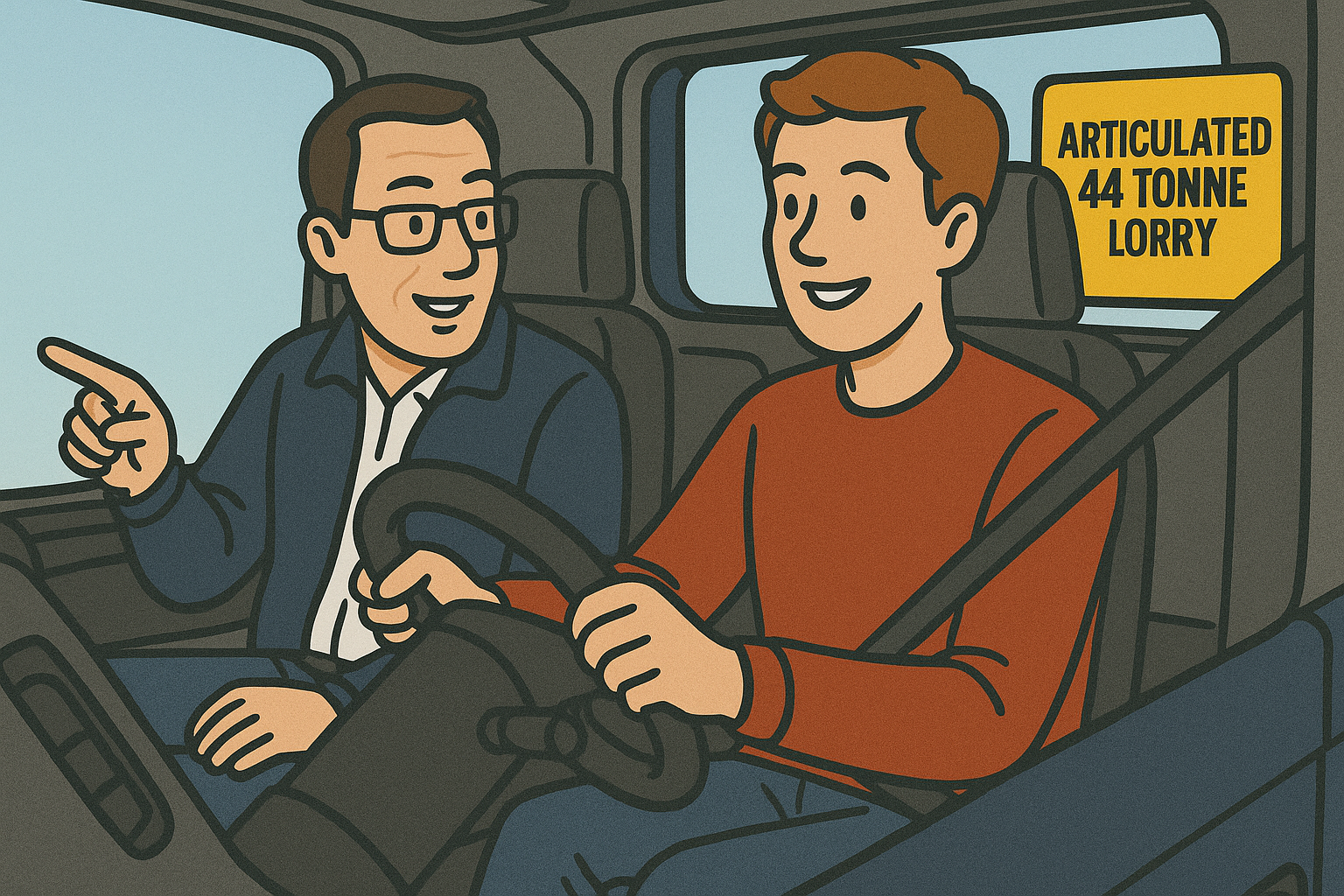
The learner, often wearing a hi-vis vest, is seated in the driver’s seat, usually a younger or mid-age adult. They wear a seatbelt and show a focused, slightly tense expression, gripping the large steering wheel.
-
The instructor, a qualified DVSA-approved professional, sits to the learner’s left. They may hold a clipboard or tablet for performance tracking and note-taking.
A prominent red ‘L’ plate is displayed on the front and rear of the vehicle, indicating a learner is driving. Some schools also use dual-control vehicles, though that’s rare for articulated lorries.
3. Structure of the Lesson
An HGV driving lesson is systematic, professional, and deeply structured. Each lesson (typically 2-4 hours) may cover:
a. Pre-Drive Checks and Briefing
-
Walkaround inspection: tires, lights, brakes, coupling equipment.
-
Cab setup: mirrors adjusted, seat position, tachograph setup.
-
Discussion of the day’s objectives (e.g., reversing, roundabouts, hill starts).
b. Vehicle Controls and Handling
-
Smooth use of the air brakes and progressive acceleration.
-
Gear control (if not automatic), especially split gears and range selectors.
-
Steering: understanding the rear trailer swing, wide turning arcs, and tracking trailer movement.
c. On-Road Driving
-
City streets: dealing with tight corners, cyclists, buses.
-
Rural roads: navigating narrow lanes and variable terrain.
-
Dual carriageways and motorways: lane discipline, overtaking, and managing speed under load.
d. Manoeuvring and Reversing
-
Precision reverse into bays or loading docks.
-
Use of mirror-signal-manoeuvre (MSM) technique.
-
Coupling and uncoupling the trailer: a multi-step procedure involving landing legs, electrical lines, and air hoses.
4. Instructional Technique
The instructor uses a coaching-based model:
-
Clear, calm voice; often repeats instructions.
-
Real-time feedback: “Check your nearside mirror… good, now steer gently left.”
-
Uses reference points: “Align the trailer corner with that white mark.”
-
End-of-lesson debrief: constructive critique and praise, next steps.
If needed, the instructor may also have access to an emergency brake or override gear selector, but typically trusts verbal control unless the situation becomes critical.
5. Emotional and Psychological Aspects
Driving a 44-tonne vehicle is intimidating at first. The learner often experiences:
-
Tension, especially in narrow spaces or heavy traffic.
-
Pride, as they begin to master reversing or motorway merging.
-
Mental fatigue, from constant spatial judgment and road scanning.
The instructor acts as both a mentor and safety overseer, balancing reassurance with firm correction.
6. Progression Toward Test Readiness
Each lesson builds confidence and competence, aiming toward:
-
DVSA HGV practical test (off-road reverse, coupling/uncoupling, road drive).
-
Understanding driver’s hours regulations.
-
Basic knowledge of vehicle maintenance and fault reporting.
By the final lessons, the learner exhibits:
-
Smooth gear changes or clutch control (if manual).
-
Confident handling of roundabouts, lane changes, and trailer tracking.
-
Precision reversing with minimal correction.
-
Awareness of blind spots, pedestrian safety, and load management.


Reviews
There are no reviews yet.